 Vave
Vave- Coins
- 90
- Withdrawal limit
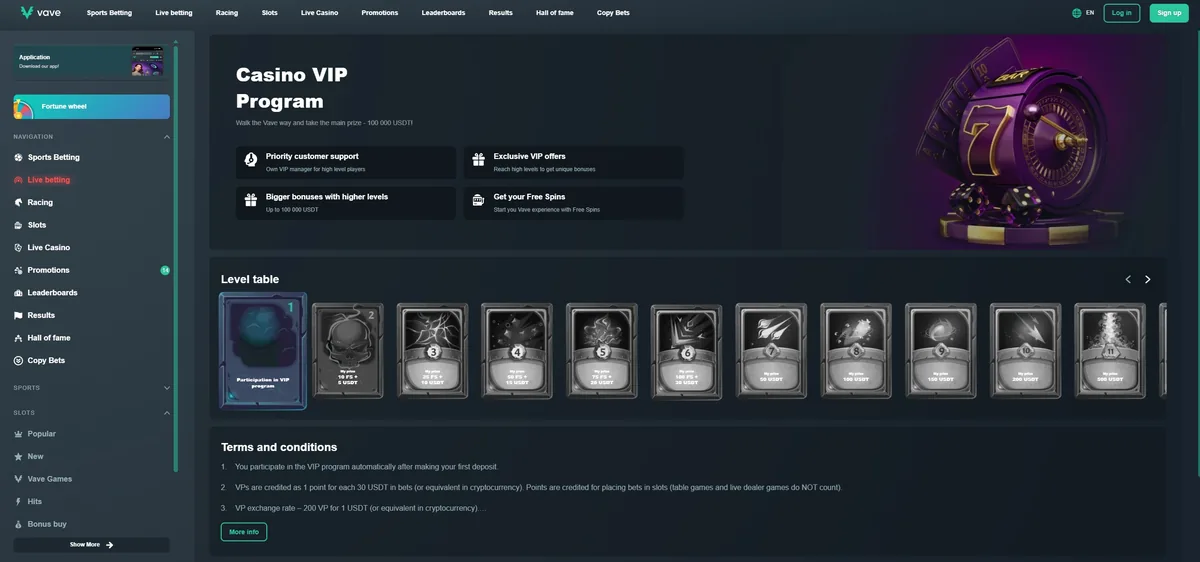
- from 50,000 USDT in instalments cl. 8.8
- Before ID check
- 180 USDT withdrawn, no ID askedtested by us
- Operator
- Latcas B.V.
- Welcome offer
- 150% up to 1.5 BTC
- Minimum deposit
- not published
- Games
- 2,500
- Studios
- 40
- Payments
- not published
- Wagering
- not published
- Licence
- Curaçao Gaming Authority
Legislation and ACMA pages read 12 September 2026
The Interactive Gambling Act 2001, read section by section
The Interactive Gambling Act 2001 is written about the people who offer online gambling to customers in Australia. This page reads its sections one at a time, follows them to the ACMA, and names the page behind every point, each checked on 12 September 2026.
Most questions about online gambling law in Australia lead to one Commonwealth statute, the Interactive Gambling Act 2001. It says which kinds of gambling service may be offered over the internet to people in Australia, who may offer them, and what a provider faces for crossing the line. The sections below were read on legislation.gov.au, and the regulator's side on acma.gov.au and betstop.gov.au, all on 12 September 2026.
A reader asking whether an online casino in Australia is legal usually means the question about themselves. The Act frames it around the provider. Quoting the wording lets the reader see that framing directly, and the summaries on this page stay close to the text.
 Bitcasino.io
- Coins
- 12
- Withdrawal limit
- not published
- Before ID check
- 2,500 EUR
- Operator
- Moon Technologies B.V.
- Welcome offer
- 100% up to 1,500 USDT
- Minimum deposit
- 0.25 USDT
- Games
- 5,000
- Studios
- not published
- Payments
- BTC · ETH · LTC · USDT
- Wagering
- 30×
- Licence
- Curaçao Gaming Authority
 Wild Fortune
- Coins
- 10
- Withdrawal limit
- 22,500 AUD /month cl. 11.8
- Before ID check
- case by case
- Operator
- Metlait SRL
- Welcome offer
- 100% up to C$3,000
- Minimum deposit
- 20 EUR
- Games
- not published
- Studios
- not published
- Payments
- BTC · BCH · ETH · LTC
- Wagering
- not published
- Licence
- Anjouan Gaming Board
 Metaspins
- Coins
- 9+
- Withdrawal limit
- not published
- Before ID check
- case by case
- Operator
- Metaspins N.V.
- Welcome offer
- 100% up to 1 BTC
- Minimum deposit
- not published
- Games
- not published
- Studios
- not published
- Payments
- not published
- Wagering
- not published
- Licence
- Curaçao Gaming Authority
 Oshi Casino
- Coins
- not read
- Withdrawal limit
- not read
- Before ID check
- not published
- Operator
- Novatrix SRL
- Welcome offer
- not read
- Minimum deposit
- not published
- Games
- not published
- Studios
- not published
- Payments
- not published
- Wagering
- not published
- Licence
- Anjouan Gaming Board
 PlayAmo
- Coins
- not read
- Withdrawal limit
- not read
- Before ID check
- not published
- Operator
- Novatrix SRL
- Welcome offer
- not read
- Minimum deposit
- not published
- Games
- not published
- Studios
- not published
- Payments
- not published
- Wagering
- not published
- Licence
- Anjouan Gaming Board
 Bitdreams
- Coins
- not read
- Withdrawal limit
- not read
- Before ID check
- not published
- Operator
- not published
- Welcome offer
- not read
- Minimum deposit
- not published
- Games
- not published
- Studios
- not published
- Payments
- not published
- Wagering
- not published
- Licence
- Curaçao Gaming Authority no number
 Bitsler
- Coins
- not read
- Withdrawal limit
- not published
- Before ID check
- case by case
- Operator
- Oyine N.V.
- Welcome offer
- 200% up to $2,000 or 100% up to $1,000
- Minimum deposit
- 5 USD
- Games
- not published
- Studios
- not published
- Payments
- crypto from a wallet or exchange · connected exchange account · card purchase of crypto (ID required) · fiat deposit
- Wagering
- not published
- Licence
- Curaçao Gaming Authority
 CoinCasino
- Coins
- not read
- Withdrawal limit
- not read
- Before ID check
- not published
- Operator
- Igloo Ventures SRL
- Welcome offer
- not read
- Minimum deposit
- not published
- Games
- not published
- Studios
- not published
- Payments
- not published
- Wagering
- not published
- Licence
- Anjouan Gaming Board
 CryptoLeo
- Coins
- not read
- Withdrawal limit
- not read
- Before ID check
- not published
- Operator
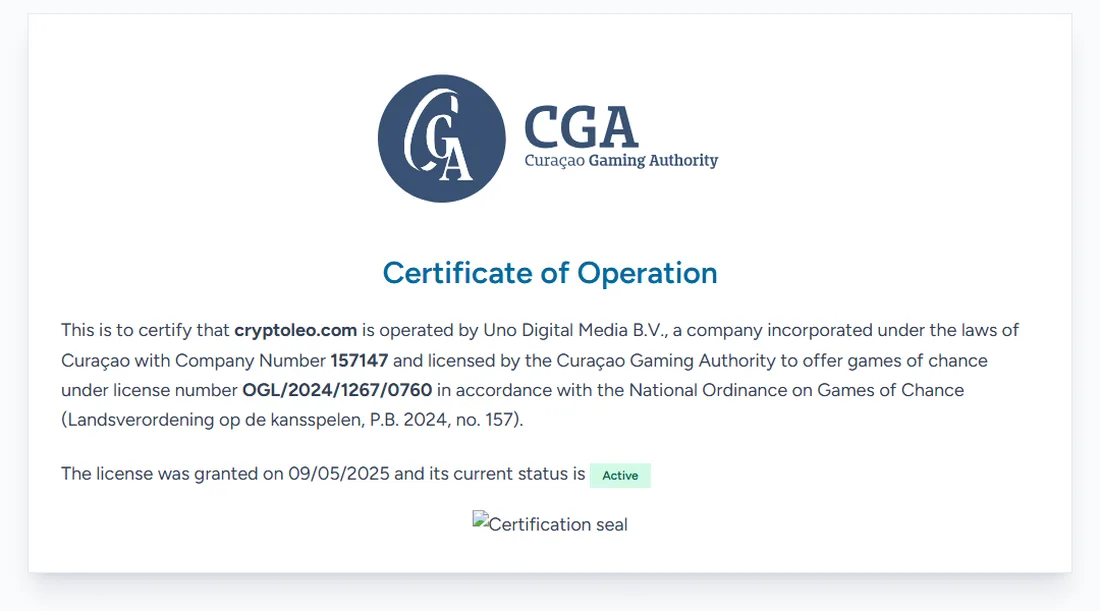
- Uno Digital Media B.V.
- Welcome offer
- not read
- Minimum deposit
- not published
- Games
- not published
- Studios
- not published
- Payments
- not published
- Wagering
- not published
- Licence
- Curaçao Gaming Authority
We deposited here. Every other cell in this row comes from Vave’s own terms, section 8, read on 25 August 2026 — and those terms publish no amount at which an ID check starts. Clause 8.7 lets the operator ask before any payout, at its own discretion. So this cell is the one figure on the page that comes from a test rather than a document. On 28 August 2026 the editorial team deposited 60 USDT on TRC20, played, and withdrew 180 USDT to the same network. No ID was asked for. That is one test at one amount on one day, not a promise the operator will do the same for you, and clause 8.7 still allows the request on any withdrawal.
The statute, its number and who runs it
The Interactive Gambling Act is Act No. 84 of 2001. The version read for this page is compilation C2024C00646, shown as in force on legislation.gov.au. Policy responsibility sits with the Department of Infrastructure, Transport, Regional Development, Communications, Sport and the Arts. Day-to-day enforcement belongs to the Australian Communications and Media Authority, the ACMA.
The operative rules are grouped in parts. Sections 15 and 15AA set out the two central offences, one for prohibited services and one for regulated services offered without a licence. Part 2A, headed “Australian based prohibited interactive gambling services not to be provided to customers in Australia”, carries the prohibition over to providers based onshore, so the same games are covered whether the company is based in Australia or overseas. Part 2B, sections 15B to 15F, deals with credit and digital currency in wagering.
Section 15 and the prohibited interactive gambling service
Section 15 is headed “Prohibited interactive gambling services not to be provided to customers in Australia”. Its criminal offence has two elements. The person “intentionally provides a prohibited interactive gambling service”, and the service “has an Australian‑customer link”. The penalty written into the section is 5,000 penalty units.
Subsection 15(2A) states the same rule as a civil penalty provision: “A person must not provide a prohibited interactive gambling service that has an Australian‑customer link.” The civil penalty is 7,500 penalty units. Set side by side, the two versions differ by one word, since the civil wording leaves out “intentionally”. The section therefore holds a criminal track and a civil track for the same conduct.
The ACMA's own list shows what falls under the prohibited heading. It names online casinos, in-play sports betting, sports betting by a provider without an Australian licence, and betting on the outcome of a lottery. Those services must also stay out of Australian advertising, and their providers must not promote or offer credit for online betting.
Nowhere does the Act use the phrase “crypto casino”. Its categories are generic, “prohibited interactive gambling service” and “regulated interactive gambling service”, and the prohibition on casino games is expressed without reference to how a customer pays. A search of acma.gov.au and legislation.gov.au for this page turned up no separate category for operators funded in bitcoin or USDT.
Section 15AA, Part 2B and the licensed side of the line
Section 15AA covers the second category, the regulated interactive gambling service. Its heading is “Unlicensed regulated interactive gambling services not to be provided to customers in Australia”. The offence needs three elements: the person intentionally provides a particular kind of regulated service, the service has an Australian‑customer link, and “the person does not hold a licence”. Penalties match section 15, with 5,000 penalty units on the criminal side and 7,500 under the parallel civil provision.
The licence is what separates the two sections. Section 15 contains no licence element, so a permit from any authority leaves a prohibited service where it was. For a regulated service, the missing Australian licence is itself part of the offence, and a provider holding one stands outside section 15AA. Licensed wagering in Australia operates through that opening.
Part 2B adds payment rules for wagering. Section 15C(1A) makes it an offence where a person “intentionally provides a regulated interactive gambling service that is a wagering service” and accepts, or offers to accept, payment through a method listed in subsection 15C(4A). Paragraph (c) of that list is “digital currency”, named beside credit cards. The criminal penalty is 500 penalty units, and subsection 15C(3A) sets a civil penalty of 750.
Sections 15D and 15E create limited exceptions, among them a provider whose annual wagering turnover is below A$30 million and a customer that is itself a gambling service provider. The digital-currency rule belongs to wagering alone. Casino-style games sit under section 15 whatever the payment method, which is why the only crypto wording in these parts of the Act concerns betting on racing and sport.
Provider and customer: where the offence wording points
Both central offences open with the same subject: “the person” who “intentionally provides” the service. The full text of the Act, read on 12 September 2026, addresses every offence and civil penalty in Parts 2, 2A and 2B to the person who provides a service, advertises it, or extends credit for it. A provision making the customer the subject of an offence did not turn up in that reading. Neither did a sentence stating in terms that a customer commits none, so the position described here is drawn from how the provisions are drafted. Part 2B follows the same pattern: section 15C is written about the wagering provider that accepts a listed payment method, and the customer figures in it as the one making the payment.
The ACMA puts it the same way on its page about the Interactive Gambling Act. The Act, it says, “makes it illegal for gambling providers to offer some online services to people in Australia”. When the regulator turns to the customer, its language moves from offences to money at risk, a point taken up in the enforcement section below.
The operators' own contracts approach the question from the opposite end. Wild Fortune, for example, prints a list of restricted territories at clause 2.4, which the customer accepts along with the rest of its terms. How a jurisdiction clause sits inside a promotion's conditions is covered in reading a bonus. A clause of that kind is a contract term with an offshore company, and it operates alongside the Act while the Act keeps addressing the provider.
Four of the ten operators compared in the Australian crypto casinos table — Bitcasino.io, Wild Fortune, Metaspins and Bitsler — state in terms read live that they accept customers from Australia; for Vave that entry remains unverified, and the other five sites could not be opened on 12 September 2026. Those statements record a commercial choice by each operator. Where a withdrawal is later held, the options still open are described on what follows a stalled payout, and the company standing behind each brand is traced on one holder, several brands.
Amendments in 2017, 2019 and 2026
The Interactive Gambling Amendment Act 2017, listed on legislation.gov.au as C2017A00085, introduced the enforcement regime now in use. The ACMA's summary under “Changes to the Act in 2017” says the law changed that year to combat groups outside Australia supplying gambling services over the internet. After it, the ACMA began publishing a register of Australian-licensed interactive wagering providers, credit lines were restricted, and the regulator gained what it calls “new tools to make people follow the rules”. It can also refer the directors and principals of an offending company to the Australian Border Force.
On the same page, the ACMA reports that more than 220 online gambling services have left the Australian market since those reforms. It adds that reports show a fall in the amount people lost to gambling services based outside Australia. A further change in 2019 allowed the ACMA to establish the National Self-Exclusion Register, BetStop, described near the end of this page.
The newest amendment is still ahead of its start date. On 19 August 2026 Parliament passed the Interactive Gambling Amendment (Gambling Reform) Bill 2026. The ACMA lists its contents as further limits on gambling advertising, a global opt-out register for gambling ads, limits on direct marketing of inducements to open new accounts, a ban on staff and affiliate commissions tied to customer activity, broader enforcement and takedown powers, and stronger BetStop provisions. “Most of the reforms commence on 1 January 2027,” the ACMA says, so the sections quoted on this page describe the Act as it stood in September 2026.
What the ACMA does: complaints, investigations and blocking
The regulator's work runs from complaint to investigation to enforcement, and its quarterly report gives the scale. The report for October to December 2025 counts 483 enquiries and complaints, 420 of them valid. It records 23 completed investigations covering 45 gambling sites and 69 confirmed breaches of the Act: 38 for prohibited services, 26 for unlicensed regulated services and 5 for advertising. Ten formal warnings went out, and 133 websites were referred to internet service providers for blocking in those three months. The breach count leans heavily towards supply: 64 of the 69 breaches concern prohibited or unlicensed services, against 5 for advertising.
The blocking power itself comes from telecommunications law. The ACMA's page on blocked gambling websites, read 12 September 2026, says it can ask internet service providers to help disrupt illegal online content by blocking access to websites, under section 313 of the Telecommunications Act 1997. It uses the power where a serious criminal or civil offence is involved and gives three Interactive Gambling Act examples: providing prohibited services to customers in Australia, providing an unlicensed regulated service, and publishing ads for either. The page links to an alphabetical list of the blocked sites, and the ACMA's Customer Service Centre answers on 1300 850 115 from 9am to 5pm AEST on working days.
Blocking began with the ACMA's first request in November 2019. Its article of 20 August 2026, the most recent of its kind found on 12 September 2026, puts the total since then at 1,788 illegal gambling and affiliate websites. The same article counts over 230 services that have pulled out of the Australian market since the ACMA began enforcing the 2017 rules, a higher figure than the one on its general page. A split of the 1,788 by type of site, whether casino, wagering or affiliate, was not located.
That article also carries the regulator's warning to consumers. Even where a service looks legitimate, the ACMA says, it is “unlikely to have important customer protections”, and Australians who use such services “risk losing their money”. The warning is framed around money and protection, which fits the structure above: the offences sit with the provider, and the risk the ACMA describes sits with the customer's balance.
What Australian-licensed online gambling covers
Online gambling with an Australian licence behind it takes two forms, wagering and lotteries, offered by an operator holding a current state or territory licence. The ACMA keeps a searchable register of licensed interactive gambling providers for checking a wagering operator before use. On 12 September 2026 it held 219 entries, each with a trading name, the licence holder, a URL and the licensing authority. The authorities listed are state and territory regulators such as Liquor & Gaming NSW and the Victorian Gambling and Casino Control Commission, and the ACMA attaches a disclaimer about liability for any loss arising from reliance on the register.
Casino-style games sit outside that register. Online slots, roulette and blackjack fall under the section 15 prohibition whatever licence a provider holds. The operators in the crypto casino Australia comparison hold or claim permits from authorities outside Australia, among them Curaçao and Anjouan, each recorded in that authority's own register. Matching a number printed in a footer to the register that issued it is worked through on terms against register.
BetStop and Gambling Help Online
The 2019 change produced BetStop, which its own site calls “a safe and free Australian Government initiative”. It lets a person block themselves from all licensed Australian online and phone gambling providers. Once someone is registered, those providers cannot let them place bets, open new accounts or receive marketing messages. The register, its periods and its registration steps are on betstop.gov.au.
For support, the ACMA's page about the Act points to two services. The National Gambling Helpline is on 1800 858 858, and Gambling Help Online offers resources and 24/7 chat and email counselling. The ACMA describes that support as free, professional and confidential, available 24 hours a day on every day of the year. The gamblinghelponline.org.au site itself would not open for the reading on 12 September 2026, so its description here is the ACMA's.
Questions about the Act
Does the Act create an offence for the person who plays?
The offence and civil penalty provisions read on 12 September 2026 are drafted around the person who provides, advertises or extends credit for a service. The customer appears in that text as the person receiving the service, and the ACMA's consumer material speaks about the risk of losing money.
Does paying in crypto change which section applies?
For casino games, section 15 applies whatever the method of payment. Digital currency is named in Part 2B, where section 15C deals with wagering services that accept it.
How many websites has the ACMA blocked?
It counted 1,788 illegal gambling and affiliate websites between its first request in November 2019 and its article of 20 August 2026.
Does the Act say anything about tax on a win?
It regulates the supply of gambling services, and tax on a customer's win belongs to the Australian Taxation Office. What the ATO's ruling and crypto pages say is set out in the tax post.
What changes on 1 January 2027?
According to the ACMA, most reforms in the Gambling Reform Bill 2026 commence that day, covering advertising, inducement marketing, commissions, enforcement powers and BetStop.