 Vave
Vave- Coins
- 90
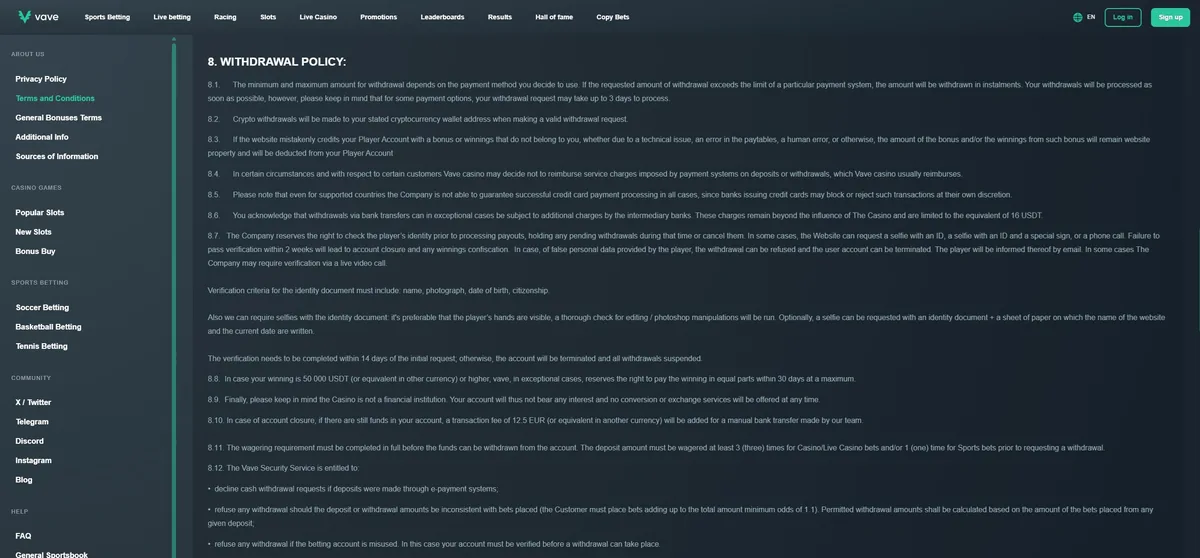
- Withdrawal limit
- from 50,000 USDT in instalments cl. 8.8
- Before ID check
- 180 USDT withdrawn, no ID askedtested by us
- Operator
- Latcas B.V.
- Welcome offer
- 150% up to 1.5 BTC
- Minimum deposit
- not published
- Games
- 2,500
- Studios
- 40
- Payments
- not published
- Wagering
- not published
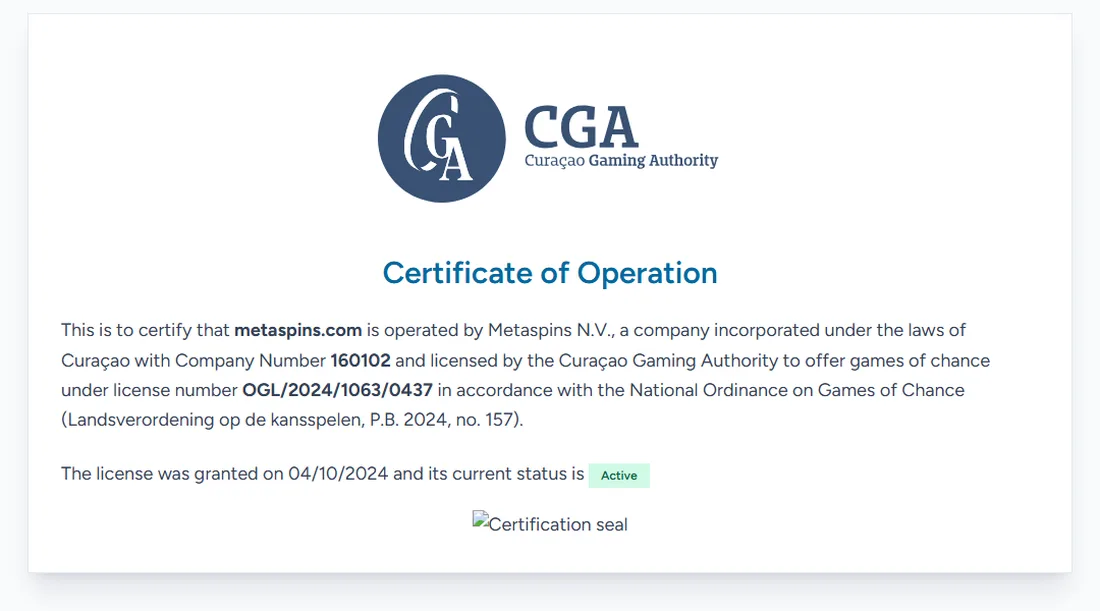
- Licence
- Curaçao Gaming Authority
Cashier first
Read the deposit page before the homepage
The cashier publishes what a welcome banner cannot. Bitcasino.io credits a deposit from 0.25 USDT and voids anything smaller under clause 5; Wild Fortune sets 20 EUR in clause 10.4 and then prints lower per-coin figures on its banking page without reconciling the two.
 Bitcasino.io
- Coins
- 12
- Withdrawal limit
- not published
- Before ID check
- 2,500 EUR
- Operator
- Moon Technologies B.V.
- Welcome offer
- 100% up to 1,500 USDT
- Minimum deposit
- 0.25 USDT
- Games
- 5,000
- Studios
- not published
- Payments
- BTC · ETH · LTC · USDT
- Wagering
- 30×
- Licence
- Curaçao Gaming Authority
 Wild Fortune
- Coins
- 10
- Withdrawal limit
- 22,500 AUD /month cl. 11.8
- Before ID check
- case by case
- Operator
- Metlait SRL
- Welcome offer
- 100% up to C$3,000
- Minimum deposit
- 20 EUR
- Games
- not published
- Studios
- not published
- Payments
- BTC · BCH · ETH · LTC
- Wagering
- not published
- Licence
- Anjouan Gaming Board
 Metaspins
- Coins
- 9+
- Withdrawal limit
- not published
- Before ID check
- case by case
- Operator
- Metaspins N.V.
- Welcome offer
- 100% up to 1 BTC
- Minimum deposit
- not published
- Games
- not published
- Studios
- not published
- Payments
- not published
- Wagering
- not published
- Licence
- Curaçao Gaming Authority
 Oshi Casino
- Coins
- not read
- Withdrawal limit
- not read
- Before ID check
- not published
- Operator
- Novatrix SRL
- Welcome offer
- not read
- Minimum deposit
- not published
- Games
- not published
- Studios
- not published
- Payments
- not published
- Wagering
- not published
- Licence
- Anjouan Gaming Board
 PlayAmo
- Coins
- not read
- Withdrawal limit
- not read
- Before ID check
- not published
- Operator
- Novatrix SRL
- Welcome offer
- not read
- Minimum deposit
- not published
- Games
- not published
- Studios
- not published
- Payments
- not published
- Wagering
- not published
- Licence
- Anjouan Gaming Board
 Bitdreams
- Coins
- not read
- Withdrawal limit
- not read
- Before ID check
- not published
- Operator
- not published
- Welcome offer
- not read
- Minimum deposit
- not published
- Games
- not published
- Studios
- not published
- Payments
- not published
- Wagering
- not published
- Licence
- Curaçao Gaming Authority no number
 Bitsler
- Coins
- not read
- Withdrawal limit
- not published
- Before ID check
- case by case
- Operator
- Oyine N.V.
- Welcome offer
- 200% up to $2,000 or 100% up to $1,000
- Minimum deposit
- 5 USD
- Games
- not published
- Studios
- not published
- Payments
- crypto from a wallet or exchange · connected exchange account · card purchase of crypto (ID required) · fiat deposit
- Wagering
- not published
- Licence
- Curaçao Gaming Authority
 CoinCasino
- Coins
- not read
- Withdrawal limit
- not read
- Before ID check
- not published
- Operator
- Igloo Ventures SRL
- Welcome offer
- not read
- Minimum deposit
- not published
- Games
- not published
- Studios
- not published
- Payments
- not published
- Wagering
- not published
- Licence
- Anjouan Gaming Board
 CryptoLeo
- Coins
- not read
- Withdrawal limit
- not read
- Before ID check
- not published
- Operator
- Uno Digital Media B.V.
- Welcome offer
- not read
- Minimum deposit
- not published
- Games
- not published
- Studios
- not published
- Payments
- not published
- Wagering
- not published
- Licence
- Curaçao Gaming Authority
We deposited here. Every other cell in this row comes from Vave’s own terms, section 8, read on 25 August 2026 — and those terms publish no amount at which an ID check starts. Clause 8.7 lets the operator ask before any payout, at its own discretion. So this cell is the one figure on the page that comes from a test rather than a document. On 28 August 2026 the editorial team deposited 60 USDT on TRC20, played, and withdrew 180 USDT to the same network. No ID was asked for. That is one test at one amount on one day, not a promise the operator will do the same for you, and clause 8.7 still allows the request on any withdrawal.
The cashier is the only pre-deposit document
A casino homepage has a single job: move you toward a sign-up. The cashier has a different job. It must list what the casino will take, at what minimum, and under what conversion. That makes the deposit page the only part of an online crypto casino you can inspect before you commit money. A review that skips the cashier is reviewing theatre.
When you open a cashier at an Australian crypto casino, read the coin list before the welcome bonus. Some sites advertise a wide range of tokens on the landing page, then the cashier shows only a couple of chains live. The cashier is where the marketing ends and the settlement begins. A missing coin there is the current policy rather than a technical delay.
The comparison table on this site exists because cashiers differ more than homepages. One cashier may accept a stablecoin on several networks and charge no deposit fee; another may accept that stablecoin on one network and quote a fee only after you paste an address. Those differences change what a deposit is worth. For any crypto casino Australia residents might open, the pattern is the same: the table is ordered so you can see that before you open an account.
Coins and chains are listed where marketing is not
A coin and a chain are different facts. A cashier that names a token has said half of it, and the network is the other half. The same ticker on the wrong chain can mean a slow confirmation or a failed deposit. A marketing page rarely separates the two, because the separation is unglamorous. The cashier has to separate them if it wants to settle a deposit at all.
Australian crypto casino sites often display a row of logos and a sentence about fast payments. The cashier, by contrast, shows a dropdown or a field. That field is a statement of fact. If the field offers a coin only as a mainnet address, the deposit will move at mainnet speed and cost whatever the network charges. If it also offers a faster layer, the fee and speed are different. The homepage stays quiet about that; the cashier answers it.
For crypto gambling australia, the coin list is a choice each operator makes and revises for itself. With the format left to the operator, a chain missing from the cashier is a signal. Either the operator declined that coin on that chain, or the settlement path was never built. Either way, the cashier is the authority. When a chain is absent from a cashier, that operator's entry among the bitcoin casinos in Australia reads missing rather than unsupported.
Minimum deposits and network fees are separate questions
A minimum deposit is a rule. A network fee is a cost. They usually share one small line and answer different questions. The minimum sets the smallest amount an operator will credit; the fee sets how much the confirming network takes before the casino sees the remainder.
The published minimums on this table span three orders of magnitude. Bitcasino.io lists a per-coin table starting at 0.25 USDT, calls its maximum unlimited, and adds in clause 5 that deposits below the minimum are void: neither credited to the balance nor returned to the sender. Bitsler sets $5 per cryptocurrency for a wallet deposit and states no maximum, though clause 8.6 reserves one. Wild Fortune's clause 10.4 asks for 20 EUR, then its banking page publishes lower per-coin crypto figures — 0.0001 BTC, 0.01 ETH, 1 DOGE — and reconciles neither against the other. Metaspins publishes nothing at all: its cashier sits behind a login.
The rule that costs most appears in none of these places. Under Wild Fortune clause 9.7, each deposit has to be staked three times over before it can leave, with no bonus involved; two deposits made without play in between are added together and wagered as one sum. Bitcasino.io clause 6.4 keeps a right to one full turnover on those terms, and Bitsler's clause 10.5 imposes one wherever a deposit is linked to a promotion. A player who deposits and changes their mind meets that clause rather than the withdrawal terms. Vave, the paid partner here, publishes no turnover condition that has been read from a document, and an unread clause is not an absent one — it is the one line this page cannot fill in for Vave.
Then the fees. Many cashiers publish a minimum and stay silent on the network fee, and that silence is itself the policy: the operator will neither absorb the fee nor name it before you commit. You read it on a block explorer afterwards. Treat an unpublished fee as a fee applicable in any amount at any time, and the same on the way out — Wild Fortune clause 11.11 caps intermediary bank charges at 16 EUR and says nothing about the crypto side.
Withdrawals have the same problem in reverse. The cashier for deposits is often clearer than the withdrawal terms. That is why the withdrawal page on this site separates the two. A casino that publishes a withdrawal minimum and stops before the processing fee has given you half a sentence. The cashier, even when imperfect, is still the better document because it is the one you see before you pay. The withdrawal ceilings page explains how much can leave in a day, which is another number worth reading before you deposit.
A house conversion rate is a price, not a detail
When an Australian crypto casino quotes your balance in AU$, something has to convert. If you deposit a coin, the cashier may show a AU$ value based on a rate the operator chooses. That rate may include a spread. The spread is a charge that bonus copy never shows. It sits between the market price and the price the casino uses to issue your balance, and even a small percentage compounds across every deposit.
Some cashiers are explicit: they say the conversion rate is displayed before you confirm. Others show only the coin amount and leave the AU$ value to appear after the deposit. That second pattern hides the spread until the transaction is done. A deposit page that withholds the conversion rate until after confirmation is asking you to sign a price you cannot see.
The same logic applies to house currencies. A site may take your coin and immediately convert it to a token it calls casino credit. The cashier may call this a convenience. In practice it is a forced conversion at a rate the operator sets. Where the terms leave the rate formula out, the rate can change between deposits. The cashier is where you should look for that formula, because the rate determines how much of your deposit actually becomes stake.
Which coins a cashier settles, and how thin the answer usually is
Coin support is the one cashier fact operators do publish, and even there the counts are uneven. Vave settles 90 coins. Bitcasino.io names 12 in its help centre — the majors plus TRX / XRP / ADA / DOGE / BNB / MATIC / TON — while its own deposit-limits table adds a thirteenth, SHIB, that the coin article never mentions. Wild Fortune runs 10 through CoinsPaid. For Oshi Casino, PlayAmo, CryptoLeo, Bitdreams and CoinCasino the coin cell is empty, because those five sites returned nothing readable on 12 September 2026.
Bitsler and Metaspins publish no coin list in text anywhere. Bitsler clause 8.2 points to the site itself for the list and warns that it may vary from one jurisdiction to another; its footer renders the currencies as unlabelled icons, and the cashier requires a login. Metaspins prints nine tickers only in clause 14.12, as minimum bonus thresholds, which is a bonus rule rather than a deposit method.
That is the shape of the whole page in miniature. A number appears where an operator chose to publish it, a blank appears where nobody did, and the blank is the more common answer. Two of the five read live publish no coin list in words at all, and both keep the cashier behind a login, so the only way to see what either settles is to open an account first.
Compare cashiers before you compare bonuses
A welcome bonus is a number with conditions attached; the cashier is a list of facts with gaps. You can read a bonus as a promise and a cashier as a ledger. Most comparison sites start with the promise. This site starts with the ledger, because the ledger is what survives after the bonus expires. When two Australian crypto casinos look similar, their cashiers will still differ in coin support, minimums, fees and conversion spreads. A site that ranks itself first still has to show the same cashier fields. The deposit pages worth trusting are the ones that close questions rather than open them.
The gaps matter more than the features. A cashier listing twelve coins with the fee left blank is worth less than one listing four with the fee stated and the conversion rate published: the first looks generous and resists checking, the second looks narrow and can be audited. A comparison should reward the second. A crypto casino australia may operate offshore, but its cashier is the document that declares the terms. That is the core of this page: judge a cashier by how many questions it closes before the deposit button, rather than by how many logos it shows.
Read the account section as well as the payment section, because several rules that decide what a balance is worth sit outside the cashier entirely: the clauses that need no request collects the ones on this table that run without any action from the player.
Before you fund any account, read the deposit page alongside the Act page to see what Australian law covers, and the ID check page to see when the casino may demand documents. Read it on the device the deposit will actually be made from, too: none of these ten ships an app-store client to Australia, so the cashier met on a phone is the same web page saved to a home screen, and a request begun there can disappear when the tab reloads. The cashier is where the reading starts. That same Act page also compares the restricted-country clauses, with four of the ten read, Wild Fortune's clause 2.4 listing 47 territories and Vave's list still open. For anyone who needs support, Gambling Help Online remains the first call.