 Vave
Vave- Coins
- 90
- Withdrawal limit
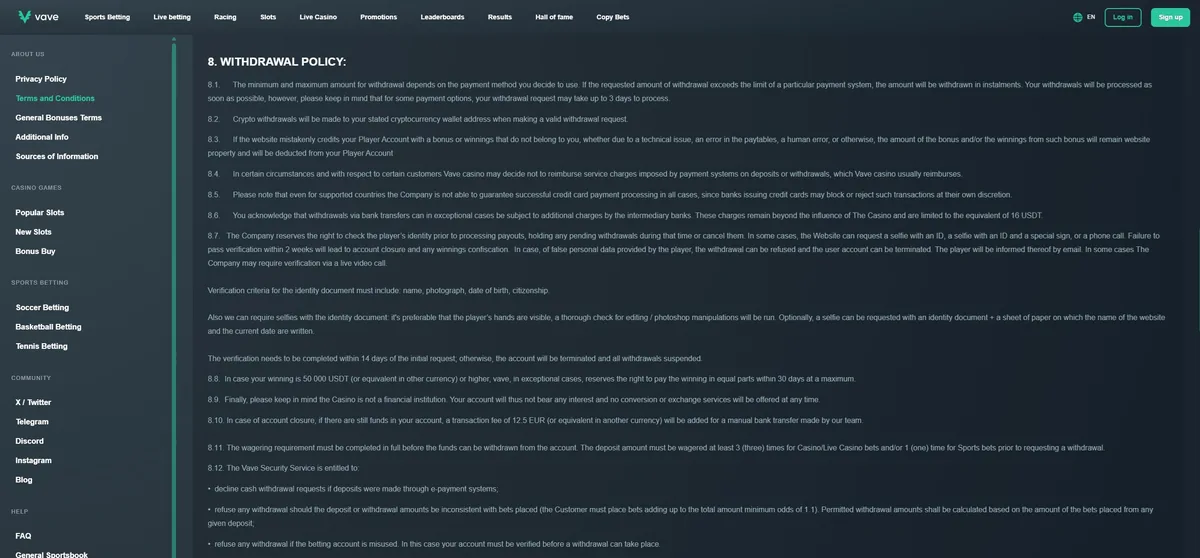
- from 50,000 USDT in instalments cl. 8.8
- Before ID check
- 180 USDT withdrawn, no ID askedtested by us
- Operator
- Latcas B.V.
- Welcome offer
- 150% up to 1.5 BTC
- Minimum deposit
- not published
- Games
- 2,500
- Studios
- 40
- Payments
- not published
- Wagering
- not published
- Licence
- Curaçao Gaming Authority
When the request sits pending
Three routes, and only one of them holds the money
Support channels were read for 5 of the 10 operators here, and 4 of those 5 publish the same two: live chat and email. Behind them sit two registers and one Australian regulator, and none of the three can move a balance the operator is holding.
 Bitcasino.io
- Coins
- 12
- Withdrawal limit
- not published
- Before ID check
- 2,500 EUR
- Operator
- Moon Technologies B.V.
- Welcome offer
- 100% up to 1,500 USDT
- Minimum deposit
- 0.25 USDT
- Games
- 5,000
- Studios
- not published
- Payments
- BTC · ETH · LTC · USDT
- Wagering
- 30×
- Licence
- Curaçao Gaming Authority
 Wild Fortune
- Coins
- 10
- Withdrawal limit
- 22,500 AUD /month cl. 11.8
- Before ID check
- case by case
- Operator
- Metlait SRL
- Welcome offer
- 100% up to C$3,000
- Minimum deposit
- 20 EUR
- Games
- not published
- Studios
- not published
- Payments
- BTC · BCH · ETH · LTC
- Wagering
- not published
- Licence
- Anjouan Gaming Board
 Metaspins
- Coins
- 9+
- Withdrawal limit
- not published
- Before ID check
- case by case
- Operator
- Metaspins N.V.
- Welcome offer
- 100% up to 1 BTC
- Minimum deposit
- not published
- Games
- not published
- Studios
- not published
- Payments
- not published
- Wagering
- not published
- Licence
- Curaçao Gaming Authority
 Oshi Casino
- Coins
- not read
- Withdrawal limit
- not read
- Before ID check
- not published
- Operator
- Novatrix SRL
- Welcome offer
- not read
- Minimum deposit
- not published
- Games
- not published
- Studios
- not published
- Payments
- not published
- Wagering
- not published
- Licence
- Anjouan Gaming Board
 PlayAmo
- Coins
- not read
- Withdrawal limit
- not read
- Before ID check
- not published
- Operator
- Novatrix SRL
- Welcome offer
- not read
- Minimum deposit
- not published
- Games
- not published
- Studios
- not published
- Payments
- not published
- Wagering
- not published
- Licence
- Anjouan Gaming Board
 Bitdreams
- Coins
- not read
- Withdrawal limit
- not read
- Before ID check
- not published
- Operator
- not published
- Welcome offer
- not read
- Minimum deposit
- not published
- Games
- not published
- Studios
- not published
- Payments
- not published
- Wagering
- not published
- Licence
- Curaçao Gaming Authority no number
 Bitsler
- Coins
- not read
- Withdrawal limit
- not published
- Before ID check
- case by case
- Operator
- Oyine N.V.
- Welcome offer
- 200% up to $2,000 or 100% up to $1,000
- Minimum deposit
- 5 USD
- Games
- not published
- Studios
- not published
- Payments
- crypto from a wallet or exchange · connected exchange account · card purchase of crypto (ID required) · fiat deposit
- Wagering
- not published
- Licence
- Curaçao Gaming Authority
 CoinCasino
- Coins
- not read
- Withdrawal limit
- not read
- Before ID check
- not published
- Operator
- Igloo Ventures SRL
- Welcome offer
- not read
- Minimum deposit
- not published
- Games
- not published
- Studios
- not published
- Payments
- not published
- Wagering
- not published
- Licence
- Anjouan Gaming Board
 CryptoLeo
- Coins
- not read
- Withdrawal limit
- not read
- Before ID check
- not published
- Operator
- Uno Digital Media B.V.
- Welcome offer
- not read
- Minimum deposit
- not published
- Games
- not published
- Studios
- not published
- Payments
- not published
- Wagering
- not published
- Licence
- Curaçao Gaming Authority
We deposited here. Every other cell in this row comes from Vave’s own terms, section 8, read on 25 August 2026 — and those terms publish no amount at which an ID check starts. Clause 8.7 lets the operator ask before any payout, at its own discretion. So this cell is the one figure on the page that comes from a test rather than a document. On 28 August 2026 the editorial team deposited 60 USDT on TRC20, played, and withdrew 180 USDT to the same network. No ID was asked for. That is one test at one amount on one day, not a promise the operator will do the same for you, and clause 8.7 still allows the request on any withdrawal.
The order of the routes is the whole answer
A withdrawal that has been pending for a week produces the same instinct in most people: find somebody above the operator to complain to. On this table that instinct runs into an awkward structure, because the party with the money is first in the queue and everyone else is a long way behind it.
The operator holds the balance. Nobody else in the chain does.
That is not a complaint about offshore licensing so much as a description of how these contracts are built. The registers behind these ten rows record who holds a permission; they do not sit on client funds, and they do not issue refunds. The Australian regulator has powers aimed squarely at the operator, and none of them is a payment instruction. So the routes below are ordered by what each one can actually change, which is not the order most readers try them in.
What the operator publishes as a way in
Support channels were read for five of these ten operators. Vave, Bitcasino.io, Wild Fortune and Metaspins each publish live chat and email; Bitsler publishes four — live chat, email, a help centre and a forum — and is the only row here with a public space where a stalled payout can be described where other customers can read it.
For the other five rows the field is empty, and empty means unread rather than absent. For Oshi Casino, PlayAmo, Bitdreams, CoinCasino and CryptoLeo the live sites stayed dark when we tried them on 12 September 2026, so their support pages were never opened at all.
None of that says anything about how a channel behaves once a payout is disputed. A published live chat is a published live chat: it establishes that a route exists and stops there. What it is worth depends on the clause the conversation ends up being about, and those clauses are the subject of the rest of this page.
Two habits make the first message more useful than it would otherwise be. Name the clause rather than the grievance — a request that quotes clause 8.7 and asks which document is outstanding is harder to answer with a template than one that says the payout is late. And ask for the reason in writing, because a reason given in a chat window that closes with the session is a reason that never existed. Beside each number logged against the offshore crypto casinos sits the clause a reader would quote, which is what makes that first message specific.
What a licence register can settle, and what it cannot
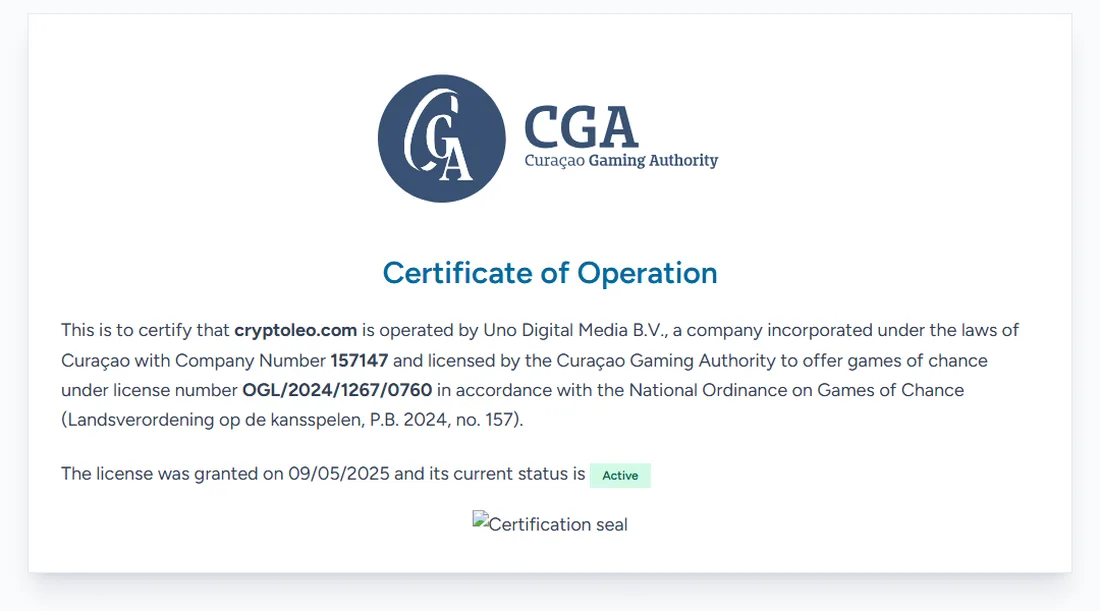
All ten rows carry a licence cell, and the register entries behind them point at two bodies. Five sit with the Curaçao Gaming Authority, four with Anjouan, and the tenth, Bitdreams, has no current entry in either. Vave here, gives Curaçao as a jurisdiction and prints no number. Its holder, Latcas B.V., has licence OGL/2024/1676/0905, which the portal showed as Active on 2 September 2026; the certificate itself lists only vavegame.com, and vave.com was absent from it when checked on 12 September 2026.
On one of these ten rows, Wild Fortune, the number the operator prints and the entry a register returns disagree. On Oshi Casino, PlayAmo and CryptoLeo a register answers and the printed side could not be compared. On Bitdreams the Curaçao certificate portal answers for the domain that the certificate is not valid. On Metaspins, both registers answer at once — Anjouan with the number the operator prints, Curaçao with a different number and a different company — and this table prints both rather than choosing one.
A register answers one question well: does this permission exist, in this name, today.
That is worth more than it sounds, because it is the only fact in the entire chain that does not come from the operator. It is also narrower than most readers expect. A register entry does not adjudicate a dispute over a balance, does not hold funds in escrow, and does not publish a decision a player could rely on later. Bitsler shows how thin the ground can be even before any of that: its terms quote OGL/2024/930/0387, which clause 1.1 describes as a pending application to the Curaçao Gaming Control Board, with trading carried on in the interim on a Certificate of Operation plus transitional arrangements.
Across the wider library of 100 operators the same pattern repeats at scale. Sixty-eight brands publish a licence number, yet the strings take just 53 separate values, since nine of them are shared out across 24 brands — the regulator licenses the company, and the company may hang as many brand names over its doors as it likes. Five brands in that library hold licences recorded as revoked, three of them sharing the single number OGL/2023/103/0067. A number in a footer is a starting point for a search, not the end of one, and the search is the part that produces the fact.
The practical use of a register during a stalled payout is therefore limited but real. It tells you whether you are complaining to a body that still has any relationship with the operator at all, which is worth knowing before writing the letter.
The regulator, and the document that governs the money
How the Interactive Gambling Act 2001 applies, and to whom, is covered in one place, on what the Act binds.
For a stalled balance the relevant point is narrower and practical. The Australian Communications and Media Authority deals with services as a whole, and its tools concern whether a service operates; a single customer's pending withdrawal sits below the level at which it works.
A payout dispute is therefore a contract dispute. The operator wrote the contract, the operator holds the balance, and the offshore licence behind it was issued somewhere else, by a body with its own priorities and its own queue.
So the operator's own terms remain the document that governs the money. It is the reason this site reads terms rather than reviews, and the reason a clause number is printed beside every figure: in a dispute, the sentence you can quote is the only leverage that was ever on offer. That rule, and the single figure on this site that did not come out of a document, are set out by the person who does the reading.
The clauses a stalled payout is usually about
Most stalls trace back to one of three clauses, and all three are readable before a deposit.
The first is verification. Where a document request is outstanding the payout is not so much stalled as suspended by design, and the clock and the consequence are set out on document deadlines. Vave gives 14 days under clause 8.7, Metaspins 30 under clause 9.10, and Wild Fortune two weeks under clauses 8.4 and 9.3.
The second is the ceiling. A balance above a published cap is not being withheld; it is being paid on a schedule, and the schedule can run for months. Wild Fortune clause 11.8 prints its own Australian dollar figures — 1,500 AUD a day, 7,500 a week, 22,500 a month — and divides anything above 22,500 into monthly instalments. Vave clause 8.8 moves anything above 50,000 USDT into instalments, and Bitcasino.io clause 6.10 lets the operator release a large win at up to 1,000,000 USDT a week, which is a schedule rather than a cap. Withdrawal ceilings separates the three rules that share that column.
The third is the satisfaction clause. Bitcasino.io clause 6.5 holds back or slows a withdrawal until the operator is content with the documents it has received, and its AML policy sets out what happens at the far end: an incomplete due-diligence check suspends the relationship, and if the relationship is terminated the funds kept back are moved to a seized funds account and a suspicious activity report is filed. That is the most consequential paragraph in this entire set of documents, and it is not in the terms at all — it is in a separate policy most readers never open.
What to keep, and when to keep it
Everything useful in a dispute is easier to collect before there is one.
Save the terms as they stood on the day of the deposit, with the date. Terms change overnight, operators do not publish diffs, and a clause that has since been redrafted is very hard to argue about from memory. A saved copy costs nothing, and months later it is the one version certain to describe your own transaction.
Record the licence number, the issuing authority and the holder company, because those three together are what a register search needs, and the footer that carries them can change too. The same three fields fill the licence column for every crypto casino Australia readers will find on the main table. Where the terms and the register disagree, record both, since the disagreement is itself the finding: a licence cell carries two claims that print identically, and only one of them was written by somebody other than the operator.
Then read the two clauses that decide who wins an argument: the one about verification and the one about forfeiture. Where the identity check sits covers the first across the table, and the cashier covers the screens where the second usually first appears in front of a reader.